Musings on misunderstanding pricing models in a given private school.
Introduction #
In the wild, people tend to like linear models a lot, and such mechanisms tend to help them manage complex circumstances easily, familiarly, until it breaks. Lately, there’s been a lot of these events happening, even as a joke.
As anything written here, for overcomplicating, for objectively analysing, and all the craziness in the world, let us model stuff and get to the end of it.
A tuition evolution problem #
Context #
A private school has a tuition for a given student, and it offers discounts for families with more children. The study subject is quite reasonable, and has a consistent model. Basically, if there is more than one child, every child gets a 5% discount, although they phrase it strangely.
They set it, in two steps:
- The second child gets a 10% discount
- Any subsequent child gets a 5% discount
The devil is in the details, because they have different tuition for nursery($t_n$) and kindergarten($t_k$). This makes some difference, but as both are similar($t_n \sim t_k$), we approximate it to a normalized tuition $t$, for our purposes.
Modelling a simpler accrued tuition #
Assuming this normalized tuition $t$, the accumulated $a(n)$ for $n$ children looks something like:
\[ a(n) = \begin{cases} t, n = 1\\ t + 0.9 t, n = 2\\ n \times 0.95t, n \geq 3 \end{cases} = \begin{cases} t, n = 1\\ n \times 0.95t, n \geq 2 \end{cases} \]Wouldn’t this be more elegant?
Modelling fantasy: greed is good #
The dark arts of pricing stimulated the minds of some parents, and they were thinking if the discount would apply to each child. This means a couple with 2 children would get a 10% discount on each child, and not only for the second.
The fantasy evolved in the discussion, and should it be so, by the $11^\text{th}$ child, there would be no tuition to pay, and by the $12^\text{th}$ they’d get paid.
What a greedy, yet creative, scheme this is?
This whole affair reminded me of Wall Street, and Gordon Gekko.

Gordon Gekko on his mythical exposition.
Data and graphics #
We an observe the following table on both of these models, that it checks out.
| $n$ | real $t$ | fantasy $t$ |
|---|---|---|
| 1 | 1.00 | 1.00 |
| 2 | 1.90 | 1.80 |
| 3 | 2.85 | 2.10 |
| $\ldots$ | $\ldots$ | $\ldots$ |
| 11 | 10.45 | 0.00 |
| 12 | 11.40 | -2.40 |
| $\ldots$ | $\ldots$ | $\ldots$ |
| $n$ | $0.95 \times n $ | $(1 - 0.1 \times n) \times n$ |
It can be simpler to check out the following plot.
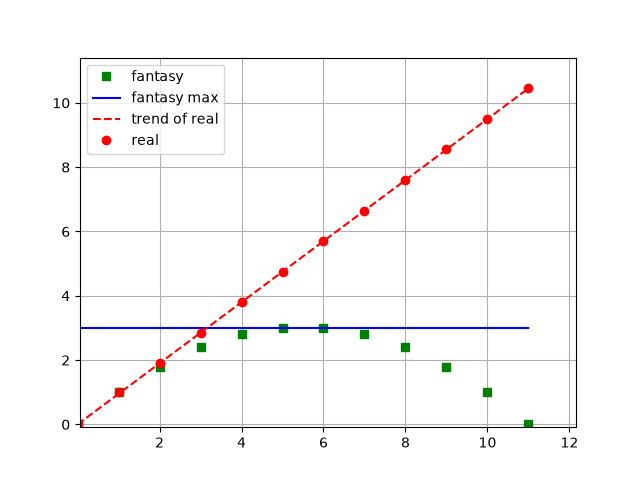
Bad code for the plot in tuition.zip.
Conclusion #
We must then conclude that pricing is a dark art, which hides a lot of the softer sciences. It also poses other questions, such as what are some design flaws to this system of pricing?
Should the pricing of the kindergarten be higher than the nursery, could the older child get the 10% discount, as the second to be enrolled in a given year?
Could the parents of two children, who are best friends, co-parent and get a 5% discount on the whole bundle? Would it be pushing to much to optimize expense in these troubling times?
In the fantasy model, a whole class could “co-parent” and my no tuition, and even get paid to have their students study at this prestigious school. Wouldn’t that be a catch!
There are funny ways to get around systems, and too much lack of common sense can allow. Never forget! It takes a village to raise children, and in some systems to get paid for it.